
It’s undeniable that AI in accounting is incredibly hot right now. Honestly last thing I imagined when studying my accounting degree over a decade ago was that it’d become one of the hottest topics in the world.
Even with the rise of AI, the fundamental layer of accounting hasn’t changed.
TRUST.
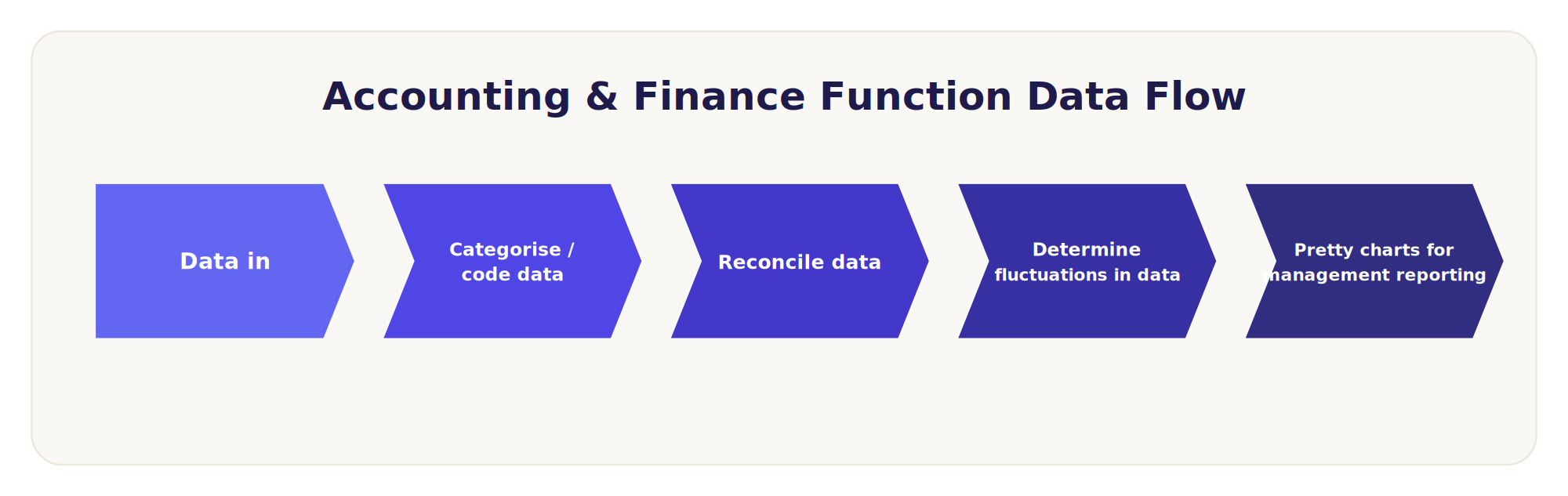
Finance and accounting in businesses should be a well oiled machine. It’s a universal flow that happens across all organisations.
Underlying all of that though is trust. Management must trust that the numbers are correct, they must trust that the variance between time periods and accounts is correct. That trust comes from accurate data.
So sure, AI can automate your accounts payable. AI can automate your accounts receivable. Claude has connections into QBO and Xero. AI-native ERPs like Campfire and Rillet are taking the world by storm. However the premise has never changed, garbage in is garbage out. To quote the Nutri-Grain ad from when I was growing up:
You only get out what you put in.
And if books close on the 10th of the month and then you have management reporting on the 14th, it’s an absolute scramble for the finance manager to get everything together in time.
The prompt quality absolutely does not matter if you’re prompting trash.
So what do we do about it?
Data hygiene and quality is the cornerstone of any strong finance function and that doesn’t change with AI.
We call the below Pulsify’s hierarchy of AI-accounting needs. Thanks Maslow.
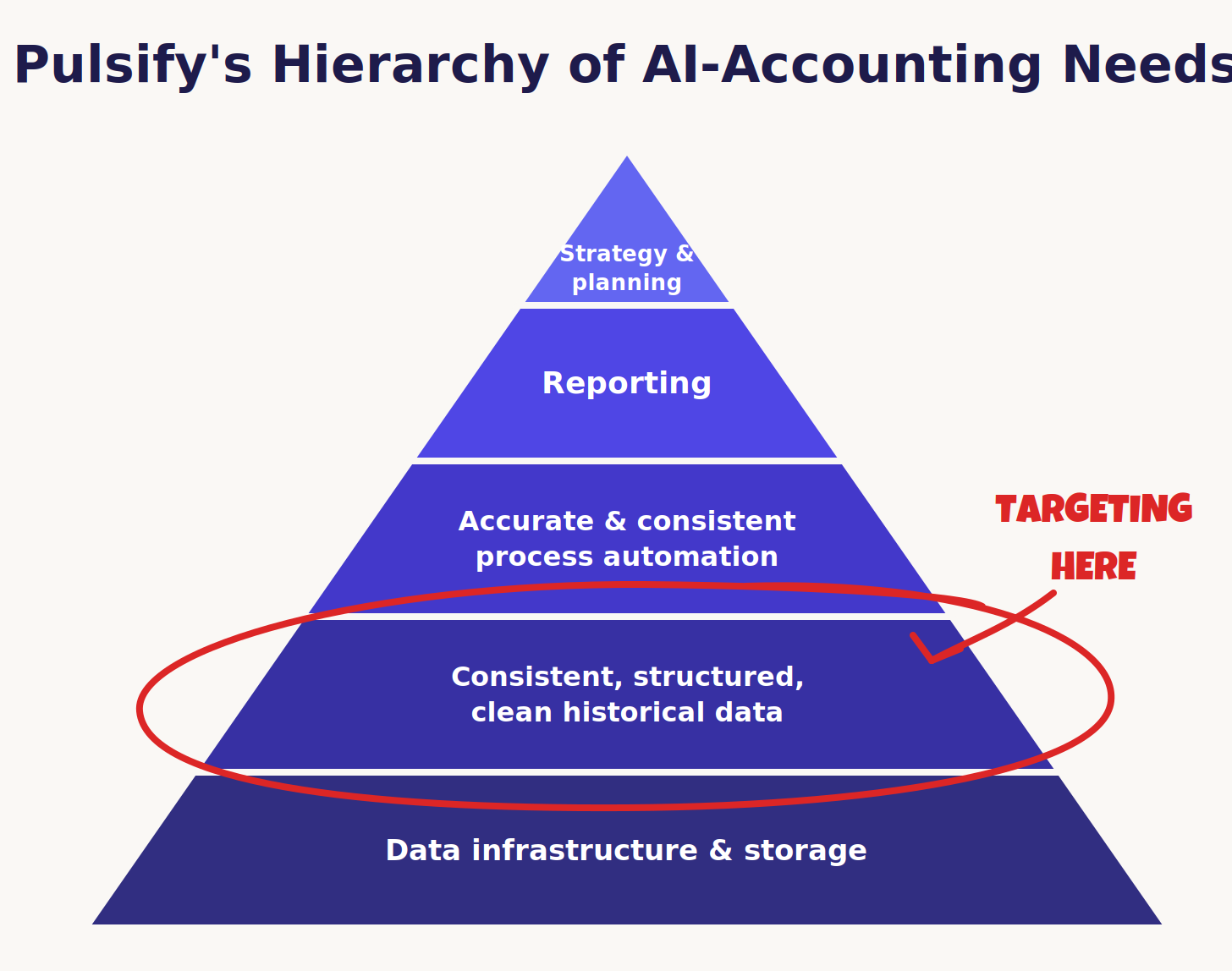
So how do you coordinate your data in such a way that you can trust the outputs and build a solid pyramid base?
First thing’s first - you need structured, consistent and clean data.
I’d start with a stocktake of how you actually absorb data. Seriously, every touch point that you have is important. Emails, Karbon, Xero, MYOB, Excel, Google Sheets, CRMs, DropBox. You get the idea.
Then standardise, templatise and structure everything that you can. Consistent column names in documents, chart of accounts, file names. It’s a lot faster to scan documents knowing that their name is Q4_2025_P&L vs P&L2025v3_vFinal. Many tools can do this for you.
Folder structures and metadata.
AI is literal. Ask it to pull consulting revenue for Q3, but your chart of accounts has Consulting, Consulting AU, and Advisory. Now imagine you’re a fresh grad and you’re allocating a cost to this line. My guess is you have to ask your manager what the difference is between the accounts. Well AI systems just might not. You didn’t specify so it guesses based on what’s most probable. Could be right, could be wrong but that uncertainty is the difference between a clean P&L and misguided management reporting. That’s how we get hallucinations.
Auditing the data structure and fixing inconsistencies:
- Check for duplication and inconsistent naming conventions. Imagine a multi-currency P&L with one cell saying $1000, and another just saying 1000. 1000 what? The system has to guess.
- Mixed data types and formats, e.g. May 15th vs 15/5.
- Even something as trivial as hidden characters. Your formulas will read double spaces as different characters.
Funnily enough one of your existing LLMs should be able to do a good first parse at this. Stay tuned in our prompts, skills and agents library. We’ll post one there shortly.
You’ve got clean historical data, what next?
Well now it’s a lot easier to connect multiple systems and get them talking to each other.
Backtest! Before you go forward look to see how the system would’ve performed looking back. Take a couple of periods you’ve closed and understand well. Run your skill (a multi-step prompt) over the raw data and see if it can reproduce the story you know is true. You knew marketing was up in Q2 because of a conference. Or that increased performance marketing spend drove client acquisition. If your system isn’t able to explain a past that you understand, personally I wouldn’t be comfortable with it explaining the future.
Use a tool like Claude Cowork (personal favourite). It lets you connect multiple tools and write a skill, whether that’s variance commentary, board deck prep or something else. It won’t work the same for everyone, so iterate, but it’s a great starting point to test your output.
System is producing reliable results?
Awesome. Trust is paramount and getting the right outputs is essential. Like we said earlier, you only get out what you put in. And doing the heavy lifting up front sets yourself and team up to building an AI system that is able to scale into clean, repeatable workflows.
Now that you’ve got clean historical data, we’ll talk more in our next post about how to continue bringing in consistently clean data going forward.